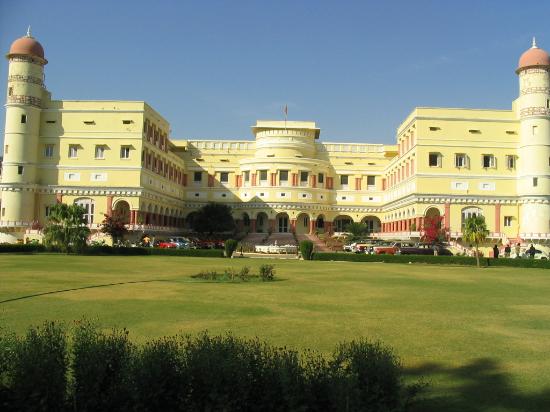
 The Sariska Palace stands proud of its royal and historic origins. The palace, designed by a French architect in 1892, was built under the patronage...
Kathakali
Showing posts with label Delhi. Show all posts
Showing posts with label Delhi. Show all posts
Wednesday, October 13, 2010
The Sariska Palace
The Sariska Palace stands proud of its royal and historic origins. The palace, designed by a French architect in 1892, was built under the patronage...

Delhi Weekend Getaways

The Delhi Weekend Getaway suits to the needs of those who covet for fun filled time with their spouse or friends in weekend. Book Delhi weekend getaway package on attractive rates and discounts.
 Gone are the days when Delhi was just known for its heritage monuments. The New Delhi Weekend Getaway package is especially developed for fun enthusiasts and adventure lovers. The tour takes in the most popular destinations nearby New Delhi like Agra, Alwar, Bharatpur, Corbett, Gurgaon, Gwalior, Jaipur, Kasauli and Manesar. These cities are situated in vicinity to New Delhi(0-500kms), hence minimum time is consumed in the journey and maximum time in sightseeing. The major attractions of the tour takes in Keoladeo Ghana and Corbett National Park, picturesque Taj Mahal, City palace and Hawa Mahal which leaves an everlasting impression on tourists. The world class hotels with top notch facilities are provided for an optimum accommodation in the tour.
Thursday, December 3, 2009
Delhi profile
Delhi is located at 28°37'N 77°14'E? / ?28.61, 77.23, and lies in northern India. It borders the Indian states of Uttar Pradesh on East and Haryana on West, North and South. Delhi lies almost entirely in the Gangetic plains. Two prominent features of the geography of Delhi are the Yamuna flood plain and the Delhi ridge. The low-lying Yamuna flood plains provide fertile alluvial soil suitable for agriculture. However, these plains are prone to recurrent floods. Reaching up to a height of 318 m (1043 ft), the ridge forms the most dominating feature in this region. It originates from the Aravalli Range in the south and encircles the west, northeast and northwest parts of the city. Yamuna, a sacred river in Hinduism, is the only major river flowing through Delhi. Most of the city, including New Delhi, lies west of the river. East of the river is the urban area of Shahdara
Climate In Delhi
The National Capital Territory of Delhi is spread over an area of 573 sq mi or 1,484 km², of which 783 km2 (302 sq mi) is designated rural, and 700 km2 (270 sq mi) urban. Delhi has a maximum length of 51.9 km (32 mi) and the maximum width of 48.48 km (30 mi). There are three local bodies (statutory towns) namely, Municipal Corporation of Delhi (area is 1,397.3 km2 (540 sq mi)), New Delhi Municipal committee (42.7 km2 (16 sq mi)) and Delhi Cantonment Board (43 km2 (17 sq mi)).

Delhi has a semi-arid climate with high variation between summer and winter temperatures. Summers are long, from early April to October, with the monsoon season in between. Winter starts in October and peaks in January and is notorious for its heavy fog. Extreme temperatures range from -0.6 °C (30.9 °F) to 47 °C (117 °F). The annual mean temperature is 25 °C (77 °F); monthly mean temperatures range from 14 °C to 33 °C (58 °F to 92 °F). The average annual rainfall is approximately 714 mm (28.1 inches), most of which is during the monsoons in July and August. The average date of the advent of monsoon winds in Delhi is 29 June.
How To Reach Delhi
By Air:
Delhi Have Two Airports
1. Domestic Airport : Palam Airport.
2. International Airport : Indira Gandhi International Airport.
By Railway:
Two Main Railway Station connecting all over India,
1.New Delhi Railway Station
2.Old Delhi Railway Station
Delhi Have 3 ISBT (Interstate Bus Transport)
1. ISBT Kashmeri Gate Connecting Haryana, Punjab, and Some Of Uttra Khand (Uttranchal). # Bus Service to Pakistan (DTC's Delhi-Lahore-Delhi Bus Service) is also Available.
2. ISBT Kale Khan Connecting Rajasthan, Some Part Of Haryana, and Some Part Of Uttar Pradesh.
3. ISBT Anand Vihar Connecting Rest Of Uttar Pradesh and Uttra Khand (Utttanchal) and Himachal Pradesh.
Travel Inside Delhi:
By Public Transport:

1. Delhi Transport Corporation.
a) General Service for All. # Green = Non - AC, Red = AC
Rates of D.T.C buses click here
.jpg) 2. Local Train Service.
2. Local Train Service.3. Metro (Expanding very quickly)

By Other Means:
1. Auto Rickshaw

2. Private Tourist Buses

3. Taxi

4. Private Cabs (Dial-A-Cab)

'Last But Not The Least "Walking By"!!!'
Delhi Lounging
Delhi, the capital of India, has a number of hotels to suit all budgets that offer world-class facilities and pleasing ambiance. India is known for its ancient tradition of treating guests as Gods and most of the hotels in Delhi leave no tables unturned to make you feel comfortable and at home. Professional yet always eager-to-serve-you staff, variety of cuisines and delicacies and all the basic amenities and luxuries are taken care of to make your visit to the hotel a memorable one.
10 Best Buy Hotels in Delhi
 Taj Palace Hotel { Rs. 17000 }
The Taj Palace Hotel, is a perfect embodiment of all qualities synonymous with the quality of Taj Hotels. Standing apart in service, its facilities and of course, in its distinguished patronage, this hotel has played host to Heads of State, corporate moguls and high profile businessmen... visit
 The Taj Mahal Hotel { Rs. 10000 }
One of the most distinguished addresses in the national capital, The Taj Mahal Hotel is located in the exclusive residential area of Lutyens' Delhi, close to the seat of government... visit
 The Ambassador { Rs. 5300 }
Inspired by colonial charm, this hotels design offers a palette of local colors, materials, and fabrics. Nearby, there is much to see and do including Lodhi Gardens and Humayan's Tomb. visit
 The Oberoi { Rs. 16500 }
The Oberoi New Delhi reflects the city's spirit in a harmonious blend of tradition and contemporary sophistication. Located close to the city center, near the business, commercial and shopping districts, this luxury hotel... visit
 The Connaught { Rs. 6353 }
The Connaught New Delhi is a haven of comfort and hospitality in the heart of the capital city. Located in the vicinity of the Railway Station and well connected to the International and Domestic airports, the hotel is suitable for the discerning business traveler as well as the tourist... visit
 Rockland Inn { Rs. 3000 }
The Rockland Inn offers a perfect combination of aesthetics with all modern amenities tailor-made for corporate travelers. Ideally located in the South of Delhi, it is just walking distance from the commercial hub of Nehru Place... visit
 Shervani Hotel { Rs. 6000 }
Hotel Shervani is a three star Business Hotel centrally & conveniently located in the up market area of South Delhi & in close proximity (3 kms) to business centers like Connaught Place & Nehru Place... visit
 Hotel Ajanta { Rs. 1100 }
Located in downtown New Delhi, Hotel Ajanta is a popular choice with international budget travelers. It lies within easy driving distance of the Railway Station, Airport and the city centre (Connaught Place)... visit
 Ashok Country Resort { Rs. 6118 }
 Situated only 4 kms away from the International Airport, Ashok Country Resort is a modern 3-star hotel. A short distance from the business centre of Gurgaon, it is well-equipped to meet the needs of a corporate traveler... visit
 Radisson Hotel { Rs. 14175 }
 Located at a distance of only 4 kms from the International Airport, the Radisson is one of the most contemporary 5-star hotels in Delhi. It offers state-of-the-art amenities and close proximity to the business centers of Gurgaon... visit
Must Visit Places In Delhi

QUTAB MINAR
Qutab Minar is a soaring, 73 m-high tower of victory, built in 1193 by Qutab-ud-din Aibak immediately after the defeat of Delhi's last Hindu kingdom. The tower has five distinct storeys, each marked by a projecting balcony and tapers from a 15 m diameter at the base to just 2.5 m at the top. The first three storeys are made of red sandstone; the fourth and fifth storeys are of marble and sandstone. At the foot of the tower is the Quwwat-ul-Islam Mosque, the first mosque to be built in India. An inscription over its eastern gate provocatively informs that it was built with material obtained from demolishing '27 Hindu temples'. A 7 m-high iron pillar stands in the courtyard of the mosque. It is said that if you can encircle it with your hands while standing with your back to it your wish will be fulfilled.
The origins of Qutab Minar are shrouded in controversy. Some believe it was erected as a tower of victory to signify the beginning of the Muslim rule in India. Others say it served as a minaret to the muezzins to call the faithful to prayer.
No one can, however, dispute that the tower is not only one of the finest monuments in India, but also in the world. Qutab-ud-din Aibak, the first Muslim ruler of Delhi, commenced the construction of the Qutab Minar in 1200 AD, but could only finish the basement. His successor, Iltutmush, added three more storeys, and in 1368, Firoz Shah Tughlak constructed the fifth and the last storey.
The development of architectural styles from Aibak to Tughlak is quite evident in the minar. The relief work and even the materials used for construction differ. The 238 feet Qutab Minar is 47 feet at the base and tapers to nine feet at the apex. The tower is ornamented by bands of inscriptions and by four projecting balconies supported by elaborately decorated brackets. Even in ruin, the Quwwat Ui Islam (Light of Islam) Mosque in the Qutab complex is one of the most magnificent in the world. Qutab-ud-din Aibak started its construction in 1193 and the mosque was completed in 1197.
Iltutmush in 1230 and Alla-ud-din Khilji in 1315 made additions to the building. The main mosque comprises of an inner and outer courtyard, of which an exquisite colonnade, the pillars of which are made of richly, surrounds the inner decorated shafts. Most of these shafts are from the 27 Hindu temples, which were plundered to construct the mosque. It is, therefore, not surprising that the Muslim mosque has typical Hindu ornamentation. Close to the mosque is one of Delhi's most curious antiques, the Iron Pillar.
Jantar Mantar
A unique structure raised in 1724, now lies in the heart of Delhi's commercial centre near Connaught place. This is the Jantar Mantar, one of several astronomical observatories raised by Maharaja Jai Singh II of Jaipur. The various abstract structures within the Jantar Mantar are, in fact, instruments that were used for keeping track of celestial bodies. Yet, Jantar Mantar is not only a timekeeper of celestial bodies, it also tells a lot about the technological achievements under the Rajput kings and their attempt to resolve the mysteries regarding astronomy. The Jantar Mantar of Delhi is only one of the five observatories built by Sawai Jai Singh II, the other four being located at Jaipur, Varanasi, Ujjain and Mathura.
All of these were built as far back as AD 1724-1730 during the period generally known as the dark age of Indian history, when the last great Mughal emperor Aurangzeb had died and the Mughal Empire was rapidly declining. During this period of turmoil, Muhammad Shah ascended the throne of the Mughal Empire. As many enemies surrounded him, he sought the alliance of the Hindu rulers. Of these, the most notable was Sawai Jai Singh II of Amber, who came into limelight since the days of Aurangzeb. When Jai Singh ascended the throne of Amber in 1699, he was barely eleven, but sharp and shrewd far beyond his years. The then Mughal emperor Aurangzeb was so impressed with the young ruler that he gave Jai Singh II the title of 'Sawai', meaning one and a quarter of an average man in worth.
Astronomical observations were regularly made over here and these observations were used for drawing up a new set of tables, later compiled as Zij Muhammad Shahi dedicated to the reigning monarch. Jai Singh named his observatory Jantar Mantar, which is actually pronounced, as 'Yantra Mantra', yantra for instrument and mantra for formula. A huge sundial known as "Samrat Yantra" or 'Prince of Dials', meant to measure accurate time of the day within half a second and the declination of the sun and other heavenly bodies dominates it.
Jai Singh himself designed this yantra. Other yantras were also meant for the study of heavenly bodies, plotting their course and predicting eclipses. The two pillars on the southwest of Mishra Yantra are meant to determine the shortest and longest days of the year. Interestingly, in December one pillar completely covers the other with its shadow while in June it does not cast any such shadow at all. After the completion of the first Jantar Mantar and with a view to verifying astronomical observations made at Delhi, Jai Singh built similar, even if smaller observatories, at other important Indian cities-Jaipur, Varanasi, Ujjain, and Mathura. The Jantar Mantars may have fallen into disuse but they remain an integral part of India's scientific heritage. It presents that the spirit of scientific enquiry was not dead in India and would have yielded rich results if only an opportunity of research and development had been given to it. This monument situated just a stroll away on the Parliament Street, still remains one of the most intriguing structures of the capital, one that burst in a flood of questions inside the curious mind of the tourist
Lotus Temple {Bahai Temple}
It is a very recent architectural marvel of the Bahai faith, located in Kalkaji, south of Delhi. Shaped like a half opened Lotus flower, this temple is made of marble, cement, dolomite and sand. It is open to all faiths and is an ideal place for meditation and obtaining peace and tranquility. Bahai's Temple is a marvel of modern architecture, which is visible from several spots in south Delhi. The lotus flower signifies purity and peace, a representation of the Manifestation of God, to the people of India. This ancient symbol has been given a modern and contemporary form in the structure of the Bahai House of Worship drawing into its sanctum sanctorum people from all races, religious backgrounds and culture from around the globe. It represents the Bahai faith, - an independent world religion; divine in origin, all embracing in scope, broad in its outlook, scientific in its method, humanitarian in its principles, and dynamic in the influence.
Since its inauguration to public worship in December 1986, the Bahai House of Worship has drawn to its portals more than 50 million visitors, making it the most visited edifice in the world. People have come regardless of the scorching summer heat of Delhi, which sometimes rises above 40*C during the months of June to September, and have braced the chill and cold rains that Delhi experiences during winter. They have admired the beautiful lotus form of the Temple, and have been fascinated by the teachings of the Bahai Faith, which believes in oneness of God, oneness of religions and oneness of mankind.
Subscribe to:
Posts (Atom)
